Showing posts with label A little History. Show all posts

Saturday, November 14, 2009

Genuine Bayberry Candles

One of the most popular items now being ordered on our online shopping site are our
Genuine Bayberry Candles. They are available in 6" (approx 3 hours burn time) and 8" (approx 4 hours burn time) and come in an attractive gift box with the Brown & Hopkins logo and the following legend......"A bayberry candle burned to the socket, puts luck in the home, food in the larder, and gold in the pocket". Burned to the nub on Christmas Eve and New Year's Eve,
they bring good luck for the coming year. Now couldn't we all use a little of that!?

When colonial families settled on the Eastern seaboard, they set about on their “women’s work”. Each day, the women of the house were responsible for the cooking, cleaning and care of the home. In late fall, as the animals were slaughtered, women would begin making candles for the following year. The average home would require approximately 200 - 400 candles to illuminate the home for a year. Tallow, or animal fat, was collected throughout the year, but slaughter always brought more fat to the home. As candle making was grueling and smelly work, the bulk of it was done in a single day.

Tallow can be quite foul after a few weeks. Imagine how much worse it must be after several months! In more affluent homes, the women would make candles from beeswax or bayberry wax, as the aroma was far sweeter than anything an animal would leave behind.

Women would gather bushels of bayberries and boil them for several hours. This heating process allowed the waxy substance to seep from the berries. As the wax has a natural buoyancy, the wax floated to the top of the kettle. Once the wax cooled, it was skimmed off much the same way we skim chicken fat from cooled broth today. It takes approximately 15 pounds of bayberries to render one pound of wax. Bayberry wax is brittle by nature, and prone to “blooming”, which is a white powdery residue that forms on the outside of the candle after several months. Candles had to be stored in a cool flat place to protect their fragile shape.

Over time, chandlers made their rounds, relieving women of the chore of candle making. Thank goodness I wasn't a colonial woman......because if Bruce needed me to make candles from animal fat, well, let's just say......we would have been living in a very dark home!!!

Eventually, molds and paraffins were developed to replace tallow and chandlers altogether.
Our true bayberry taper candles make a very nice hostess gift on Christmas Eve or New Years Eve.

Friday, March 20, 2009

Letter from Long Ago Customer


I recently opened my mailbox to find a letter penned from Mr. Anthony Duskey of Peabody, MA.......along with a copy of a photo (sorry for the poor quality), but it is the story that is so endearing.....

Dear Brown & Hopkins,

Thought the article from The Boston Globe would be interesting together with a picture showing me at age 5 in 1942 that has a jack rabbit in it that came from your store. I just had to have that rabbit as it was out front along with other stuffed animals! We were going from Rocky Hill Road in Smithfield to Webster, MA. Our farm is now part of North Central Airport.

Through the years, the rabbit and the tricycle are gone, but the memories linger on. By the way, might you still have one of those rabbits?

Sincerely,

Tony Duskey

Dear Tony,

We don't have any of those rabbits, but sure wish we did...it looks like a Steif to me, and would be very valuable today, but probably not as valuable as the memory you just shared with us. Thank you......please visit us sometime soon!


Tuesday, January 13, 2009

A Most Interesting Story!!!!!!

It is amazing what can be found with google!!!
Reprinted from The Providence Journal
2.28.99
Thriving Villages
Now little more than bedroom communities, the villages in the far reaches of the state thrived with their own industry, entertainment and identity.
By BRIAN D. MOCKENHAUPTJournal Staff Writer
Tell someone in Providence that you're taking a trip to Burrillville or Foster, and you might hear some variation of the quip: "You better pack an overnight bag."
But one hundred years ago, that wasn't far from the truth. Most of the roads in the northwest corner of the state were dirt, cars were scarce , and travel was often by horse or foot. Now little more than bedroom communities, the villages in the far reaches of the state thrived with their own industry, entertainment and identity. There were the larger villages -- Pascoag, North Scituate, Harrisville -- and the smaller villages now all but forgotten -- Huntsville, Moosup Valley, Cherry Valley. "People who live in Cherry Valley are still quite proud of the fact that they live in Cherry Valley," says Edna Kent, Glocester's historian.
In Glocester, the center of town was Chepachet. At the start of the 19th century, it was known as a trading hub. Gradually it became a mill village, but the mills in Chepachet declined through the later part of the 19th century, Kent says. The last big mill, White's Mill, burned in 1897. It was burned, Kent says, for the insurance. "The gentleman who was the night manager, the superintendent, he had never taken a vacation and he was approached by this brother of the man who lived across the street from the mill and he said, `You work so hard, why don't you take the day off and I'll watch it for you.' And that night it burned. "As the story goes, that man never came to town again," Kent says. "He just couldn't set foot in town. It just broke his heart. He loved that mill." Kent says the burning of the mill, which employed many people at the time, "cast a pall over the community."
"At the turn of the century," she says, "it would have been rather quiet." But Kent says it wasn't just the loss of the mills that hastened Chepachet decline. In the mid-1800s, there was talk of bringing the railroad to Chepachet, linking it to Providence. The farmers, however, "were afraid the engines would cause the hay fields to burn. "They refused it," Kent says. "That's why it went to Burrillville." In Burrillville, business was booming and mills were everywhere. "That was the big industry here," says Joyce McKenna, president of the town's historical society. "That was about all there was. Farming wasn't much of an option." Pascoag and Harrisville were the centers of activity in Burrillville. For entertainment, there were music halls, a theater, and taverns. "Where there were mills, there were bars," McKenna says. "That was pretty much a given." And Burrillville had the railroad. So until 1914, when the electric trolley came to Chepachet from Providence, many people traveling into Glocester took the train to Oakland in Burrillville, then the stage coach into Chepachet. Though the mills were in decline, Chepachet was still a busy place. Henry Taft, who ran the giant Chepachet Inn, continued having his famous game dinners, featuring fish, venison, pheasant and grouse caught in the area. "He used to go hunting and fishing with his guests as well," Kent says. In 1902, the Rhode Island Automobile Club took over the inn. Automobiles were still an anomaly in the area. Some well-to-do owned cars; everyone else walked, rode atop a horse or behind one in a wagon or carriage. Nevertheless, Kent says, "With autos, it lost some of its intimacy." With autos, the village also lost its horse racing. Before cars were common in Chepachet, residents used to hold horse races down Main Street. "It was called the Half Mile," Kent says, and it ended in front of what is now the Brown and Hopkins store. While the auto ended the betting on horses, it also helped Providence discover Chepachet. The Providence Journal wrote this in July 1907: "One of the most picturesque and interesting of the older villages of Rhode Island, yet long one of the most inaccessible by the usual methods of transportation, Chepachet is being discovered by the automobilist as it was several years ago by the bicyclist, and is becoming one of the most popular runs out of Providence. "The distance is only 40 minutes or so by motor. It's a pleasant run of 16 miles through an interesting country. . . ." The trip became easier when the electric trolley came to Chepachet, running on the hour from 6 a.m. to midnight from Providence. Of course, Chepachet itself didn't get electricity until 1922. This meant no refrigeration in the early part of the century. During the winter, ice from ponds was sawn into blocks and carted to ice houses, where, with a thick layer of sawdust for insulation, the blocks could stay solid into the summer. Residents could have ice delivered to their homes, along with meat, fish, bread and milk. Those who lived in the country side mostly made due on their own, raising some crops and some animals, Kent says. But some things did draw them into the village.
In 1906, the townspeople held the first Old Home Days, at the Freewill Baptist Church. It was a daylong picnic and festival, held in August, meant to bring people together. And it showed, Kent says, just how different the country folk were from the village folk. Those coming into the town from the countryside would not offer "Good day" as a greeting but "How sare ye?" a throwback to Colonial times. In fact, Kent says, people from West Glocester often had different speech patterns from those from a village as close as South Glocester. "They just lived in the neighborhood, they didn't go anywhere," Kent says. "They came into town four or five times a year, the rest of the time they just stayed on the farm. They didn't have a chance to hear other types of speech." The celebration grew in size each year, though the church and the rest of the village was nearly burned to the ground in 1907 when fire destroyed several buildings after somebody put a pail of hot coals on the back porch of Bob Wade's general store. The stairs ignited and the fire soon spread to three nearby houses and several barns.
Kent says her mother in law, who was an organist for an East Providence church at the time, had driven a horse and wagon into Centredale, then taken the trolley to East Providence. "On her way back, when she got to the stable at Centredale, the man at the stable had told her Chepachet was on fire," Kent says. "Until the day she died, she regretted what she had done, but she whipped that horse all the way back." She returned in time to see the fire still burning. "At that time, we had no fire department," Kent says. "The only thing that really saved it was the winds shifted. The stiff breeze blowing to the south reversed and blew back on what had already burned."
All I can say is Thank Goodness!!!!

Wednesday, January 7, 2009

Bicentennial Kick Off Event!!!


Well, it was just 200 years ago when Ira Evans bought the building and started a general store that is now Brown & Hopkins Country Store!

Here is a circa 1930's photo of William F. Hopkins (left) and James L. Brown (center), and unknown clerk amidst the offerings at the time.....Do you see the Mary Janes!!???
Yup, we still have those!! Well, not the same ones! See, somethings never change!

Well there have been a few changes.....


For one, there is no longer a spit box...thank goodness!!!

And we don't sell ammo.....or tobacco products! Both very popular items in the circa 1900 inventory ledger on display at the front of the shop.


Here are the details of our


Bicentennial Kick Off Event!


January 15th, 16th, 17th & 18th!

We are giving away 200 free gifts!!
Be one of the first 50 customers each day to receive your free Thank You Gift!!

25% off hand painted signs by Poor Boy Signs!!!

We have stocked up and have a great selection of these popular signs!


Plus, register to win a $200 Gift Certificate!!!!

Of course, we'll have lots of refreshments and goodies for you to sample!

Won't you join us?

Reminder....we are closed from January 8th thru January 14th to paint, fluff and restock!


Tuesday, December 23, 2008

Project Blue Light


Yesterday a customer "enlightened" us to
Project Blue Light.......

It’s just one blue light bulb,
but it can have a profound impact on those who choose to protect and serve.
Project Blue Light, a long-standing tradition that involves placing a blue light in the window of a home during the holidays, has become a way of recognizing the service of law enforcement officers who are serving communities and those who have fallen in the line of duty.
Ricky Parks, a Rocky Mount senior police officer and sergeant-at-arms for the N.C. Fraternal Order of Police, said the gesture is appreciated among the law enforcement community.
“One blue light in the window honors those injured or killed in the line of duty, and those on the street,” Parks said.
Project Blue Light was initiated in 1988 in Pennsylvania, after a woman whose son-in-law was killed in the line of duty began the practice of putting a single blue light in an electric candle in the window of her home, according to the Concerns of Police Survivors Web site — an organization for families of fallen police officers that promotes Project Blue Light.
Parks said he encourages as many people as possible to display a blue light in the window of their homes to show support for all law enforcement officers.

This blue star bulb is available while supplies last at Brown & Hopkins. It fits into our little electric window candles, just perfect for your window sill.

Wednesday, September 24, 2008

My Choice For President

I usually don't talk politics,
but recently I saw a T-Shirt at The Big E
that really says how I feel about this upcoming election....
And as we were walking the fair,
I bumped right into my choice for President!!!
Did you know that Abe and Brown & Hopkins
will both be turning 200 years old in 2009???

Gee, Abe you look good for your age!!!
Abe had some great quotes,
and we have quite a few of his reproduced
in framed prints...come on in and check 'em out!

Wednesday, August 27, 2008

Sticky Situation ~ A Tale from Yesteryear


The Night They Moved The Post Office

Of all the moves made by the Chepachet Post Office, none was more memorable to Robert Steere than the exodus out of our Brown & Hopkins Store to diagonally across the street to the Hawkins' building (now "Post Office Antiques")

Helen Steere Brown wrote
in her book "Looking Back"........

"It was an evening in summer, and Joshua Angell had come up to the village of Chepachet from South Glocester to buy a jug of molasses. Instead of returning right away, he stayed to watch them dismantle the pigeon holes and paraphernalia and move them to the new location. He set his jug of molasses on the floor. It was a hot day and it overflowed.

Bob, who was about 10 years old at the time, stepped into the molasses with his bare feet. Instead of cleaning them off, he walked home down the unpaved road through the village, collecting dust and dirt all the way. Upon arrival, his feet escaped notice, and he went to bed ~still covered with molasses and part of Main Street.

By next morning, both molasses and Main Street had left their mark upon the sheets, and the discovery..................

led to dire consequences which Bob vividly recalled for the rest of his life."

Thursday, July 17, 2008

Old Guys in Pick-up Trucks


The other day as I was driving to work, I was behind a pick-up truck filled with old stuff. I was thinking to myself...."I wonder where he got all that great stuff...", and "I wonder how I can get a better look at it?". As I passed the vehicle I turned my head to get a better glimpse of the driver, a cute old guy with blue eyes, he motioned to me asking me if I wanted to look at the stuff in the back of his truck. I thought he looked harmless enough, so at the red light we decided to meet up in a nearby parking lot to assess the situation. (And this is where I say to myself....."I am my mother after all! LOL" Celia loved trash to treasure finds!) He had just finished cleaning out a barn in Massachusetts, and came away with a very shabby chic 20's Hoosier, a matching wall cupboard, a big black blanket box (would make an awesome coffee/game table!), an oak ice chest (needs refinishing, these make great liquor or Tupperware cabinets!) and a few other little things. But the most exciting find, was a "grabbit" (that's what I call it anyway)....a contraption to help shopkeepers reach canned goods off of high general store shelves! How ironic! It was as if this whole episode was a meant to be moment!
Here's a little history on one of my favorite finds.......


The Housewife’s Helper…Hoosier Cabinets
There’s a lot of debate about the origin of the word, but when it comes to antiques, a “Hoosier” is widely recognized as one of the most sought-after collectibles. The name came to refer to a free-standing, multi-use kitchen cabinet for the simple reason that the most popular version was produced by the Hoosier Manufacturing Company in New Castle, Indiana. Most of the company’s competitors were also based in the Hoosier State—Sellers of Elwood, Boone of Lebanon, and Coppes Nappanee offered comparable products in the first few decades of the twentieth century. The classic Hoosier cabinet stood six feet tall, was made of oak, pine, or later enamel, and featured closeted upper and lower storage spaces, bisected by an often collapsible wooden, zinc or porcelain counter. Many models included a built-in flour sifter, pull-out bins, ant-traps and racks for pots and pans. Other Hoosiers revealed a remarkable array of amenities—from a fold-out ironing board to a desk with pigeonholes and a pencil drawer.
The emergence and popularity of the Hoosier cabinet correspond with changes in society taking place a century ago, especially with regard to the woman’s role and domestic life. In the post-Civil War era, women trying to function in smaller urban quarters without servants turned to a steady stream of technological advances for the home. The compact efficiency of the Hoosier cabinet appealed to the turn-of-the-century homemaker, and the Hoosier Manufacturing Company turned out at least 600 a day. A study commissioned in 1920 by the U.S. Department of Commerce found that use of such a workstation could save the American housewife over 1500 of the 2000-plus steps she took in her kitchen every day. “After these amazing discoveries,” an ad in the Ladies Home Journal read, “no woman will end another day footsore and weary. None will endure the distressing fatigue of kitchen work any longer.”
Don't ya just love the verbage in old advertising? In the blanket box there was a newspaper from the 50's with great ads for old automobiles.....I would have loved to have grown up in the 50's......it looked like so much fun!

Looking for some fun this weekend?
Gather some friends and take a drive to Brown & Hopkins. Shop in our air conditioned store, sample some cheddar cheese and lots of new dips we just got in!!! It's going to be too hot to do anything else!

Thursday, June 12, 2008

Thank Your Teacher!!!


And thank your lucky stars that she doesn't carry a wooden ruler
like Clara Barton probably did.....
This is a portrait of Clara Barton.
She was an American teacher, nurse, and humanitarian.
During the Civil War, Clara brought comfort to countless injured soldiers and prisoners.
She was recognized by many Union Generals,
and Abraham Lincoln for her selfless service during the war.
We have some great teacher gifts...that don't look "teachery".....
and that is what, if you are planning on giving a thank you gift,
teachers of today would really appreciate!
Perhaps something like a small gift certificate
to Brown & Hopkins ~ their favorite county store!!!!
Of course we have lots and lots of other ideas.....
from $3.95 and up, and each comes with free gift wrapping!
We are open til 7pm on Thursday for last minute shopping!

Monday, May 19, 2008

Well....I NEVER!!

Never have seen another table like this one, that is!

It is an ironing board table, manufactured by the Martin-Reed Table Company of Hartland, VT I imagine it was constructed some time in the early 1900's, however I haven't been able to gather any historical information yet, to date.
About 5 years ago, I purchased this unique gem at an antique store. I just fell in love with the color...a red, with lots of paint splats! And the fact that the ironing board section folds up and can be hidden beneath the lift top.....Magnificent!! Tell me I live under a rock, but I had never seen anything like it! In the instructions, it tells you about ironing skirts, so it has to have been made when big skirts were the rage. If anyone can tell me more about this table, please email me at shopkeeper@brownandhopkins.com
All I can say is, Thank Goodness for modern conveniences!
I iron everyday, but don't think I would like to do it the old fashioned way!

Wednesday, April 2, 2008

Chair Today ~ Gone Tomorrow!

Today we received in over a dozen windsor chairs!
(not to mention 18 big boxes of great country stuff!)
I am exhausted!

Barbara said it looked like a Quaker Meeting House!
Looking back through American history,
Windsor chairs can be seen in many notable places
as documented through paintings.
As a matter of fact, George Washington himself
fancied Windsor chairs - with a recorded
27 Windsor chairs at his Mount Vernon home.
Thomas Jefferson is said to have written a draft of
the Declaration of Independence while seated in a Windsor.
When the Declaration was signed in
Philadelphia’s Independence Hall on July 4, 1776,
the assembly sat in Windsors.

Our beautiful windsor chairs are made of a hardwood,
painted black and given a timeworn look.....
and very reasonably priced!
They are available in side chairs and arm chairs.
These particular chairs were special orders for two customers....
so have no fear, they are not blocking the candle display any longer....
Wouldn't you love a set of new chairs for your home?
They look wonderful with our new Rustic Farm Table!
The farm tables are available in any size, with or without company boards!
Come in soon to check them out!

Saturday, March 29, 2008

Wall Of Honor

This is just a smattering of what you would see
upon entering our 199 year old country store...
We call it our Wall of Honor.
It's a collection of various items sold through the years,
collected by past shop owners (there's only been about
17 different owners in 199 years!), and
placed on display behind the 20 foot long counter.
Many folks often comment on the
Cut-Rite Wax paper box, still filled
with wax paper and priced at just 29 cents....
Or the Red/Blue Combination pencils....
"Do you remember using those in school?", is often
overheard when referring to these gems.
Sorry, but the antiques on display on
the Wall of Honor are not for sale.
They are just for taking you down Memory Lane......
Enjoy the journey....

Saturday, February 16, 2008

Presidents Day

Like I mentioned before, since acquiring ownership of Brown & Hopkins, I am much more interested in history. In fact everyday, while I am walking about the store, displaying merchandise or helping a customer, the following thought is always in the back of my mind... "I wonder who has walked these very same floor boards as I do everyday???? Imagine the possiblities!" I find it amazing that Abraham Lincoln was actually born the same year that Brown & Hopkins was incorporated, in 1809. Abraham Lincoln was born on February 12, 1809, to Thomas Lincoln and Nancy Hanks, two uneducated farmers, in a one-room log cabin on the 348-acre Sinking Spring Farm, in southeast Hardin County, Kentucky. The above portrait is available for purchase at Brown & Hopkins, among many other Abe Lincoln prints pertaining to his many famous quotes.....
Here are a few of our favorites....
'Most folks are about as happy as they make their minds up to be.'
'It is better to remain silent and be thought a fool
than to open one's mouth and remove all doubt.'
'And in the end, it's not the years in your life that count.
It's the life in your years.'

We will be open on Presidents Day from 10am to 5pm.


Tuesday, February 12, 2008

Inventory Book from 1901

Now that I am older, I appreciate history so much more....
When cleaning out Brown & Hopkins a few years back I came across this old inventory book from 1901......gosh, I finally took the time to actually read some of the pages, and it is so interesting!!! Next time you are in the shop, just ask for a personal viewing.....
Here are just a few pics of it.......

If you notice on the page marked "Barn", they noted that they had three horses,
and their names were Jim, Prince and Charlie ~ valued at $300

I am not sure if that is each or their combined value......

Want to read this inventory page...click on photo to enlarge! And when I read the page with all the different oils listed, it reminded me of a story that my Mom, Cecilia, once told to me......
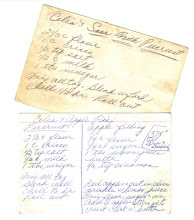

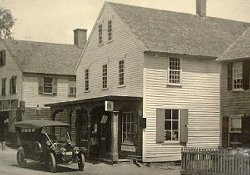
When my mom was a little girl, she summered with a mean lady that used to make her work in the garden even on the hottest of days. She couldn't have been more than 7 years old. One day, my mom complained of a stomach ache so she could get out of working in the field......which kind of backfired. The old woman said "Oh, I have the perfect cure for a stomach ache. It is castor oil. However, if you drink this and do NOT have a stomach ache, it will make you very very sick." Needless to say, that scared my mom into a miraculous recovery.

Castor oil has been used medicinally for about 4,000 years; and, until recently, it was given regularly to children to "keep their systems clear". Because of its unpleasant taste, castor oil is a remembered bane of many a childhood.